AI-built · 3D packaging
The 3D Packaging Tool I Shipped Without Writing Code
How I conceived, designed and shipped Fold solo, with AI as my build team: from idea to a live 3D product in four weeks, then 8 production releases in 7 days.
Year :
2026
Industry :
Packaging · D2C
Client :
Own product
Project Duration :
4 weeks to launch

The Problem: Packaging Is Judged in 3D but Designed Flat
In 30 seconds: Fold lets brand owners pick a real box, design all six sides, turn it in 3D and export a printer-ready dieline. I conceived, designed, tested and shipped it myself, with AI as my build team and without writing a line of code. It went from idea to live in four weeks, then shipped 8 production releases in its first 7 days, with zero rollbacks.
D2C founders and small brands need packaging, but they aren’t packaging designers. They don’t own Illustrator or ArtiosCAD, and they don’t think in dielines. Packaging is designed flat, yet judged in the hand, in 3D. Most brand owners only see the real result when a printer’s sample comes back, which is slow and costly. Agencies are out of reach for early-stage brands, and generic design tools don’t understand flaps, faces or print.

The Approach: Calm by Default, Precise Where It Counts
I set one design principle before building further: Apple’s calm, with Figma’s precision only inside the properties panel. Everywhere else gets one primary action, plain words and no noise. The test for every change: if it adds noise outside the properties panel, it doesn’t ship.
Because the users aren’t designers, I chose guidance over options: real box structures instead of a blank canvas, a Sample or Blank design to start from, and plain language instead of print jargon.
My role covered the whole product: idea, UX and UI, art direction, QA and release decisions. AI did the building. I designed reference prototypes of the key screens first, then directed the build in plain language: first with Codex for v1, then with Claude for every release since. [verify you’re happy naming both tools]
Before going fast, I set up a release process: every change on its own preview, tested on a QA link, live only on my “release”, with one-tap rollback from my phone.

What I Built, and the Decisions Behind It
Fold supports six real box structures in three sizes each, including mailer and sleeve boxes with real print dielines. Brands design all six sides with text, 22 shapes, images and brand colours, then see the box live in 3D.
The decisions that mattered most came from how printing really works:
Kraft tints the board, not the ink. The first version laid kraft over the artwork and white ink disappeared. I moved it under the artwork, so white stays white, as it does on a real press.
Window cut-outs are real cut lines, knocked out in the dieline, not just a picture of a window.
Every image gets a print-quality badge, Good or Low, based on its resolution at the size placed on the box. It warns before the printer does.
Background removal has two modes: remove white, or remove only around the artwork. The second keeps the whites inside a logo, which is what real logos need.
And the decisions that kept it calm:
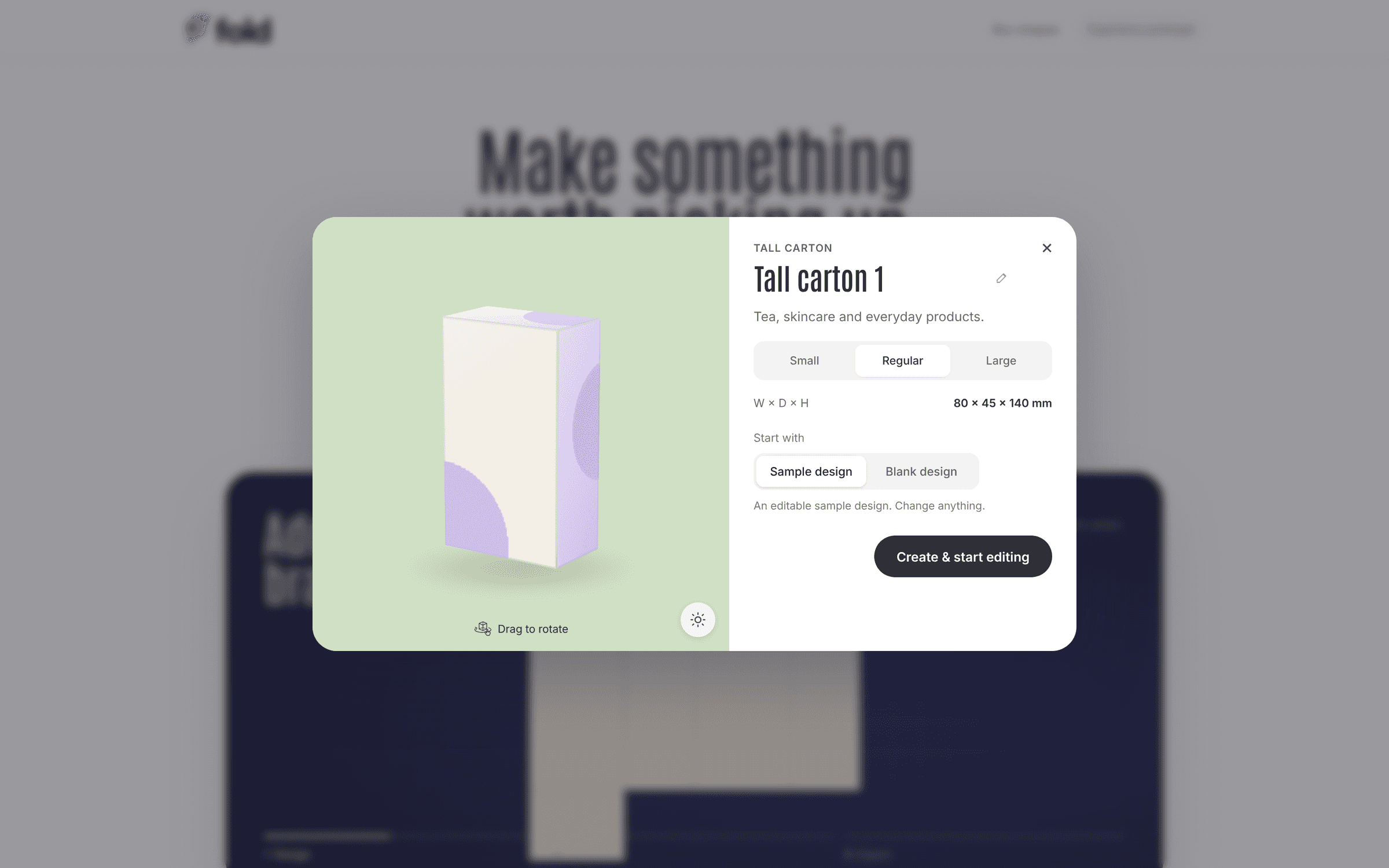
Choosing a box went from two steps to one popup: preview, size, sample or blank, name, create. The decision happens while you’re looking at the box.
Popups never scroll. If it doesn’t fit on one screen, the content is too long, so I cut it.
Mobile is preview-first. Editing six sides on a phone is a poor experience, so phones get view, 3D and mockups, and desktop-only actions say so plainly.
The Impact
The numbers from the first month:
Metric | Result |
|---|---|
Idea to live product | ~4 weeks [verify] |
Production releases in the first week | 8 in 7 days |
Pull requests shipped | 30 |
Rollbacks needed | 0 |
Photo storage per image | 2 MB → 300 KB (−85%) |
Box structures at launch | 6, in 18 sizes |
Early beta users and a first conversation with a D2C snack brand shaped the roadmap within days. When one user asked whether they could paste images from the web, paste, a print-quality badge and background removal shipped the next day.
Why This Matters
AI makes building fast, but it doesn’t make products good. The difference was judgment: knowing which print realities to respect, which features to cut, and when to stop and test. Fold shows that a designer who sets the bar, the principles and the release discipline can now ship a real product end to end.


More Projects


AI-built · 3D packaging
The 3D Packaging Tool I Shipped Without Writing Code
How I conceived, designed and shipped Fold solo, with AI as my build team: from idea to a live 3D product in four weeks, then 8 production releases in 7 days.
Year :
2026
Industry :
Packaging · D2C
Client :
Own product
Project Duration :
4 weeks to launch
The Problem: Packaging Is Judged in 3D but Designed Flat
In 30 seconds: Fold lets brand owners pick a real box, design all six sides, turn it in 3D and export a printer-ready dieline. I conceived, designed, tested and shipped it myself, with AI as my build team and without writing a line of code. It went from idea to live in four weeks, then shipped 8 production releases in its first 7 days, with zero rollbacks.
D2C founders and small brands need packaging, but they aren’t packaging designers. They don’t own Illustrator or ArtiosCAD, and they don’t think in dielines. Packaging is designed flat, yet judged in the hand, in 3D. Most brand owners only see the real result when a printer’s sample comes back, which is slow and costly. Agencies are out of reach for early-stage brands, and generic design tools don’t understand flaps, faces or print.
The Approach: Calm by Default, Precise Where It Counts
I set one design principle before building further: Apple’s calm, with Figma’s precision only inside the properties panel. Everywhere else gets one primary action, plain words and no noise. The test for every change: if it adds noise outside the properties panel, it doesn’t ship.
Because the users aren’t designers, I chose guidance over options: real box structures instead of a blank canvas, a Sample or Blank design to start from, and plain language instead of print jargon.
My role covered the whole product: idea, UX and UI, art direction, QA and release decisions. AI did the building. I designed reference prototypes of the key screens first, then directed the build in plain language: first with Codex for v1, then with Claude for every release since. [verify you’re happy naming both tools]
Before going fast, I set up a release process: every change on its own preview, tested on a QA link, live only on my “release”, with one-tap rollback from my phone.
What I Built, and the Decisions Behind It
Fold supports six real box structures in three sizes each, including mailer and sleeve boxes with real print dielines. Brands design all six sides with text, 22 shapes, images and brand colours, then see the box live in 3D.
The decisions that mattered most came from how printing really works:
Kraft tints the board, not the ink. The first version laid kraft over the artwork and white ink disappeared. I moved it under the artwork, so white stays white, as it does on a real press.
Window cut-outs are real cut lines, knocked out in the dieline, not just a picture of a window.
Every image gets a print-quality badge, Good or Low, based on its resolution at the size placed on the box. It warns before the printer does.
Background removal has two modes: remove white, or remove only around the artwork. The second keeps the whites inside a logo, which is what real logos need.
And the decisions that kept it calm:
Choosing a box went from two steps to one popup: preview, size, sample or blank, name, create. The decision happens while you’re looking at the box.
Popups never scroll. If it doesn’t fit on one screen, the content is too long, so I cut it.
Mobile is preview-first. Editing six sides on a phone is a poor experience, so phones get view, 3D and mockups, and desktop-only actions say so plainly.
The Impact
The numbers from the first month:
Metric | Result |
|---|---|
Idea to live product | ~4 weeks [verify] |
Production releases in the first week | 8 in 7 days |
Pull requests shipped | 30 |
Rollbacks needed | 0 |
Photo storage per image | 2 MB → 300 KB (−85%) |
Box structures at launch | 6, in 18 sizes |
Early beta users and a first conversation with a D2C snack brand shaped the roadmap within days. When one user asked whether they could paste images from the web, paste, a print-quality badge and background removal shipped the next day.
Why This Matters
AI makes building fast, but it doesn’t make products good. The difference was judgment: knowing which print realities to respect, which features to cut, and when to stop and test. Fold shows that a designer who sets the bar, the principles and the release discipline can now ship a real product end to end.